Saturday, November 29, 2008

ALERT: Appalling Security Breach


Octopuses share 'living ancestor'


By Mark Kinver Science and environment reporter, BBC News

Many of the world's deep-sea Octopuses evolved from a common ancestor, whose closest relative still exists in the Southern Ocean, a study has shown.


Researchers suggest that the creatures evolved after being driven to other ocean basins 30 million years ago by nutrient-rich and salty currents.


The findings form part of a decade-long global research programme to learn more about life in the world's oceans.

The first Census of Marine Life (CoML) is set to be completed in late 2010. The project, which began back in 2000, involves more than 2,000 scientists from 82 nations. The research into the evolution of deep-sea Octopuses was part of a programme called the Census of Antarctic Marine Life (CAML), explained Ron O'Dor, CoML's co-senior scientist.

"Many of these octopuses were collected from the deep sea by a number of the CoML's different projects," he told BBC News.

Octopus specimens collected by Census of Marine Life researchers
All of that material was brought together and made available to Dr. Jan Strugnell, a biologist at Queen's University Belfast, and she used this material to carry out DNA studies. She was looking at the relationship between these different deep-sea octopuses and how they originated. She has been able to trace the timeline for their distribution back 30 million years to a common ancestor. The species could all be traced back to a shallow-water Octopus that lived in the Southern Ocean. Today, the creature's closest living relative (Megaleledone setebos) can still be found in the icy waters around Antarctica.


Dr. O'Dor added that Dr Strugnell's work also enabled her to identify how changes in the region's ocean played a pivotal role in the development of the new species, especially the emergence of a "thermohaline expressway".

"When you get an increase in sea ice, fresh water forms ice crystals and leaves behind high-salinity, high-oxygen water, which is denser than the surrounding sea water, so it sinks," he explained.


"It gets mixed by sea currents and flows into all of the deepest parts of the ocean.


"At the time this process started, there was no oxygen at the bottom of the ocean, so it brought oxygen into these areas, and we can now see that the octopuses moved out from the Antarctic into deeper water."


Dr. Strugnell's work, supported by the UK's Antarctic Funding Initiative (AFI) and the National Environment Research Council (NERC), also showed how the creatures adapted to the new deep-sea environment.


One example was the loss of their ink sacs, because there was no need for the defence mechanism in the pitch black waters.


As well as being one of the CoML's highlights, the research is also being published in the journal Cladistics on Tuesday.


'Unprecedented project'


The deep-sea Octopus study, along with dozens of other projects, form part of the census's fourth progress report, which will be presented at the World Conference on Marine Biology, which begins in Valencia, Spain, on Tuesday.


The overarching objectives of the global collaboration between CoML's scientists include:
Advancing technology for discoveries
Organising knowledge about marine life, and making it accessible
Measuring effects of human activities on ocean life
Providing the foundation for scientifically based policies


Dr. O'Dor said that the main focus of the CoML for the remaining two years was to "synthesise" the data.


"Many of our projects have already completed their fieldwork and we have a lot of information," he observed.

"What we are now trying to do is to bring all that information together in a form that allows the public to understand how much we have learned about the ocean and what lives in it."


As far as improving our understanding of life beneath the waves, Dr. O'Dor said: "It has been successful beyond what I imagined when I first became involved.


"It will provide a baseline. We are not going to know everything about what is happening within the oceans, but we have samplings of most marine habitats.


"We are moving into this period of global warming, which is resulting in the acidification of the oceans, melting of the polar ice cap.


"We can use the first census as a benchmark to see what happens in the oceans over the next decade or more."
Meeting formally for the first time at the five-day gathering in Valencia will be the CoML's Science Council, which will take an overview of the 10-year Census.


"Over the past few years, there has been huge public interest in biodiversity because there is a legitimate concern about the changes being caused by humans," commented Patricia Miloslavich, the Census's co-senior scientist.

"The Science Council will [consider] what people have said about areas that have not been explored or taxonomic groups that have been overlooked in the past," she told BBC News.

"We have had this first census that has given outstanding and amazing results for many ecosystems and regions.

"But now that we have been able to identify where there are some gaps, we would like to explore these areas."
Dr. Miloslavich added that the Science Council will also develop the objectives of the second census, which will run from 2010 until 2020.

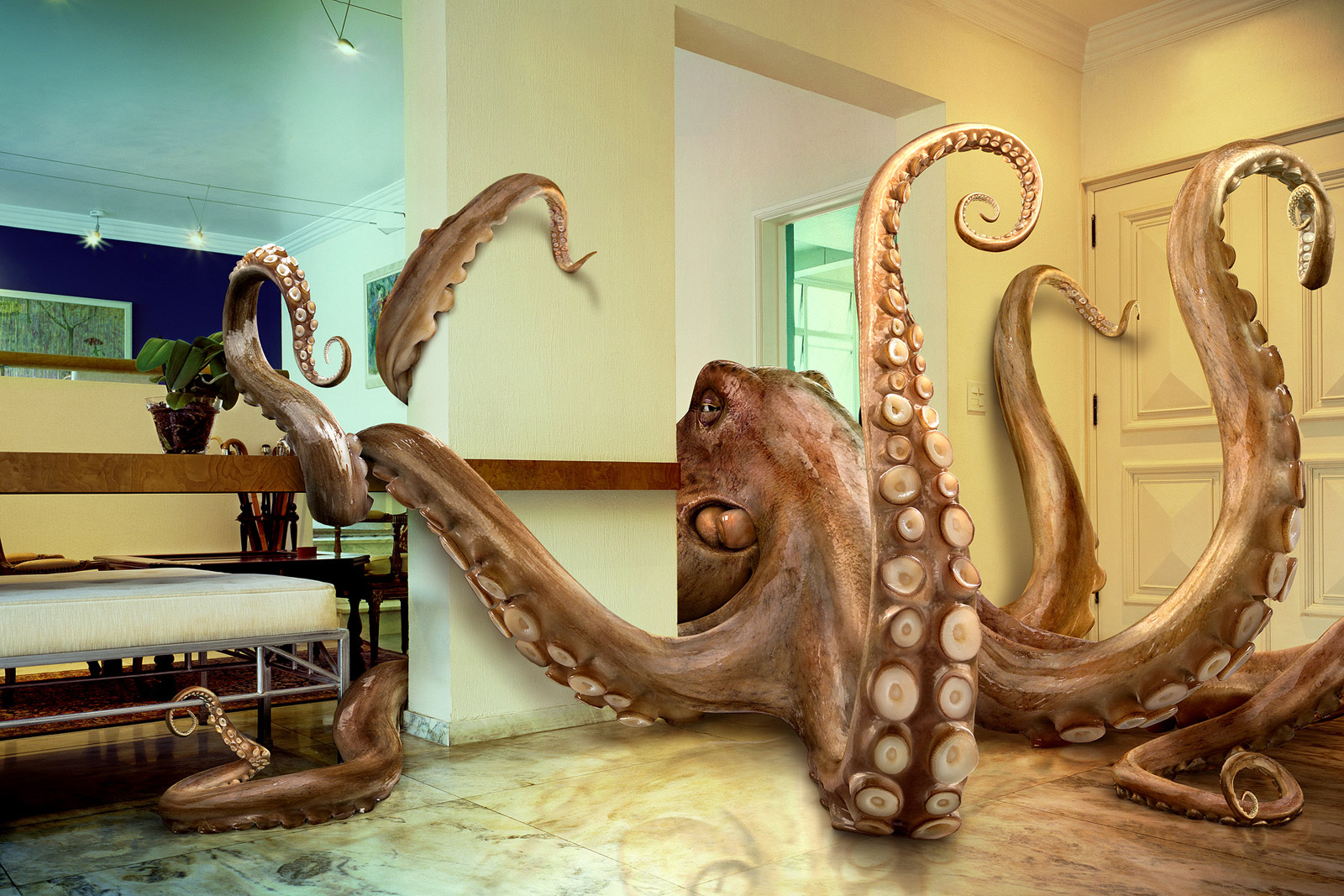
I suppose it was inevitable that the featherless bipeds would start sequencing the DNA of even deep-cover operatives like the GREAT BELOVED OCTAPOD pictured above. For once, they chose a fairly musical scientific name. NOT THAT MOST OF THE NAKED APES IN MY TERRITORY WOULD BE ABLE TO PRONOUNCE IT!

Labels: , ,

Monday, September 08, 2008

OKTAPODI


I am not normally one to post YouTube videos on my site. It's a practice too newfangled and modern for someone as ancient and wizened as I. But I had to make an exception for this. RARELY do I have the chance to review a film BY, FOR and ABOUT Octopi. If you think I am going to SPILL THE BEANS and reveal which of the filmmakers involved in this project are, in fact, disguised Octopods, you are going to be disappointed.
~
There is little in the way of actual Cliffie's Notes I can provide to enlighten the viewer about WHAT GOES ON HERE. At any rate, the film should be self-explanatory to the WATER-BREATHING viewer. Featherless bipeds may find it harder to grasp. LET ME EXPLAIN IT THIS WAY: You can no longer imagine being an intelligent prey species, but there are still PLENTY OF OTHERS OUT THERE who are in that position. You're not the only species with wish-fulfillment fantasies, OK? I know you think you are. You're not.
~
Click here to see the film in its entirety.

Labels: , ,

Sunday, February 26, 2006

POSSESSION


YOUR QUESTIONS ANSWERED BY THE ST. LAWRENCE SEAWAY ZONE LEADER!

Some of the questions that I’ve been getting in lately apply to many of you. Here goes:

Q: "Sally Lightfoot" of our Southwestern Quadrant asks why I only hint around in publications and broadcasts about the identities of operatives.

A: Well, I have to protect other people’s identities the same as I need to protect my own. It’s especially important to ensure the privacy of those who have already entered the sea and are presumed dead. We run the risk of upsetting a great many applecarts otherwise. I, for instance, live in a very public place with guided tours and stuff coming through on a weekly basis. It would get dicey if anyone knew what and who I really am. And let us never forget that we live in the Golden Age of the Nuisance Lawsuit. With today’s laws, anything is possible, and I do mean anything. I have to keep my lip zipped.

Q: A consortium of nail techs and machine-lathe operators in the Midwest forwards this always-important question: what do we do if our transformation finishes up suddenly and we are nowhere near a body of water?


A: Actually, this never happens. You can be anywhere up to about three-quarters aquatic, and still safely travel to the Gobi Desert if you want. Your transformation into your final, fully aquatic form will NOT occur, in fact CANNOT occur, until you are with easy reach of an appropriate lake, stream, pond or ocean. The water itself causes the change. Now remember, everyone: salinity DOES NOT COUNT FOR YOU the way it does for other aquatic species. You do need to avoid chlorinated water, of course. When that chemically-sterilized pool filler hits your gills, YOU WILL WISH YOU HAD NEVER BEEN BORN. You also need to be very careful about appearing in fish form in a place you’re not supposed to be. A freshwater blind cave fish caught cruising around a tide pool on Molokai is BOUND TO EXCITE COMMENT, are you getting me? Which brings us to our next question:

Q: "Ralph Bleak," writing out of the Pacific Northwest, asks what Hank and I consider the most important in terms of rank-and-file operatives protecting the secrets of our glorious Cause.

A: Don’t do ANYTHING you couldn’t explain to an ichthyologist. Let’s consider that blind cave fish again. As prone to sunburn as she is, basking near the surface will not be much of an option. She will probably be under or behind something that will make her hard to spot. But say someone does see her – especially, in the worst-case scenario, a fish-savvy native Hawaiian or one of those wretched marine biologists that infest the beaches year ‘round. Now what do you do? What you’d better do is DIE ON THE SPOT. Take your black capsule IMMEDIATELY. At that point you can be written off as a tankfish someone let loose in the ocean, and OUR SECRETS ARE SAFE.

More later. Keep those cards and letters coming. OK, now ON TO THE REVIEW!

Cliffie’s Notes on Possession

Released in 1981, starring Isabelle Adjani and Sam Neill
Directed by Andrzej Zulawski

PLOT SUMMARY: This is the uplifting story of a woman who’s had bad luck with men all her life, until she finally meets her true love: one of our own operatives, apparently some sort of Cephalopod. The story is told from the viewpoint of her husband, who comes home to Berlin from a long business trip, knowing only that his wife has found herself someone new. He starts investigating the matter and eventually finds out, well, everything. The director cleverly structures the story to make everything look one way to the landscum viewer, and another way to US.

Let’s observe for a moment the cuckolded husband in the story. Hubby is handsome, for a Naked Ape, until you notice those creepy, silvery eyes. He appears to be in some sort of shady government work, which makes you wonder if he might get arrested or assassinated one day. He’s been absent from the family’s stark, chilly-looking apartment for months at a stretch, leaving his wife so lonely that she goes out and gets someone new. Newly jobless, trying to save his family, Hubby breaks down completely and stops eating and bathing. It takes him a while to get his feces aggregated so he can fight to save his family. We finally see him come out of it enough to shamble down the hall barefoot in a sweat-stained suit jacket, with his hair pointing every whichaway, trying to find his son and reason with his wife. How long would YOU wait around for this guy?

The director paints a picture of an empty city where the romantic prospects (even for a beauty like Adjani) are bleak indeed. People are few and far between, and they stride through deserted streets, shop alone in vast, well-stocked grocery stores and meet in bars where nobody appears to spend any time. You might be desperate for love, too, in a city like this. But happily for Adjani, having given up on Mr. Absentee, she moves on from her next choice, Mr. Weirdo, to find real happiness with MR. OPERATIVE. I want to point out RIGHT NOW that this film paints an unrealistic picture of what it takes to catch the eye of a new contact, if you are an operative looking for recruits. They do NOT need to be emotionally neglected or desperate.

They may have worked the story this way because they made the operative, to Naked Ape eyes at least, pretty repulsive. Quite a contrast with the elegant and sophisticated human recruit, I mean girlfriend. I mean I realize they were trying to make a horror movie. But clearly Adjani sees the REAL BEAUTY and RAW SEX APPEAL under the slime. And when we finally get a look at his eyes, they are just the opposite of her husband’s – warm, deep and apparently comprehending everything in the Universe. You know, like a Mackerel.
You wonder how desperate she must have been to hook up with Mr. Weirdo, even briefly, especially in comparison to the unnamed operative who replaces him. Heinrich is a middle-aged man, oddly managing to be both wizened and doughy, who lives with his mother and pirouettes around the room as you talk to him, spouting pretentious horseapples about God and the greater meaninglessness of it all. He’s also quite likely to deliver a karate chop to the throat if you say something he doesn’t like. She fell for THIS? I guess we can understand why she kept looking, at least.

Funny things start happening. Hubby meets his son’s kindergarten teacher, a fresh-faced beauty who looks exactly like his wife. She sure is a lot nicer to him, though. Hubby meets Heinrich for the first time, and they don’t exactly hit it off. The private investigator hired by the husband tracks the Adjani to an empty apartment building, and then disappears. Adjani herself disappears for longer and longer periods of time. Their son starts practicing deep-sea diving in the family bathtub. A couple of people get eaten. Hubby starts to fall for the kindergarten teacher.

Hubby can no longer deny that his wife is not coming back after he walks in on her and the new fella. They’re in bed together and there is no doubt that she has found Piscatorial Love. This scene is not for the kiddies, ladies. Whoosh!

Rather unexpectedly, husband and wife are brought back together by the end of the story and are reborn into a new, better form, having been transformed by Piscatorial Love.

The operative? He gets what he always wanted: full infiltration into the landscum society, with nobody the wiser.

And what about the son? He’s left in good hands. They even let him swim in the house.

An important note: this is not an American movie. If you are hoping for a lot of car chases and starlets who can barely form sentences, forget it. This movie is characterised more by that kind of faintly surreal overacting that I associate with European avant-garde cinema. The action is all in the heads of the characters. You should also be prepared for some PRETTY GOOSHY special effects. And for all the panic, dread and raw lust we see in this movie, there is hardly a drop of affection or family feeling. Fair warning.


Labels: , , ,